-829x301.png "The Power Cart")


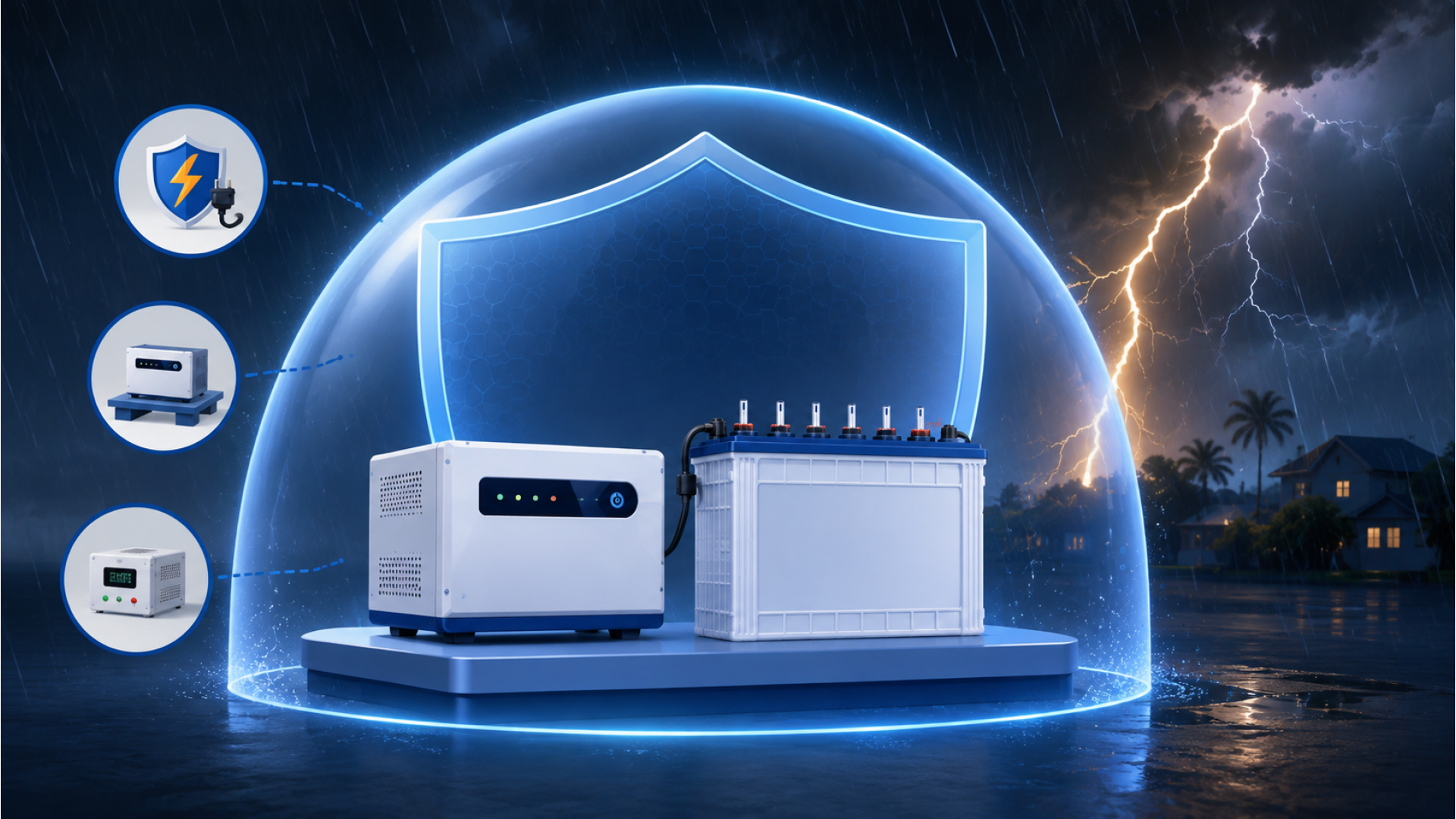
Monsoon power cuts in Delhi NCR don't behave like the summer ones. A summer outage is usually a predictable load-shedding cut — the grid strains under AC demand, and power returns in a fixed window. A monsoon outage can be a lightning-induced voltage spike that fries unprotected equipment in an instant, a waterlogged substation trip that lasts for hours, or a fallen tree that takes down a line for an entire evening. If your backup setup was chosen with only summer cuts in mind, monsoon season exposes the gaps fast.
Here's what actually changes during monsoon, and how to set up your Home UPS, inverter, and stabilizer so the setup itself survives the season along with your appliances.
Why Monsoon Power Cuts Are Different
- Lightning-induced voltage spikes: Even a nearby (not direct) lightning strike can send a brief, damaging surge through the grid into your home wiring.
- Waterlogged transformers and substations: Flooding in low-lying areas of Delhi NCR routinely trips local transformers, causing outages that last far longer than a typical load-shedding cut.
- Physical line damage: Fallen branches and waterlogged poles cause outages that can't be fixed quickly, sometimes stretching overnight.
- Unstable voltage before and after cuts: Grid voltage often fluctuates sharply as supply is restored in stages, stressing any appliance running without a stabilizer.
- Humidity: Moisture in the air affects battery terminals, inverter ventilation, and can accelerate corrosion on any exposed electrical connection.
1. Surge Protection Is Non-Negotiable
A voltage spike from a lightning strike travels through the grid in microseconds — far faster than a stabilizer's correction response. Make sure your inverter or Home UPS has built-in surge protection, and consider adding a dedicated surge protector at your main distribution board for whole-house coverage. This is the single most common gap we see in setups that survive summer fine but fail during the first big monsoon storm.
2. Pair Your Inverter With a Proper Stabilizer
Post-outage voltage restoration during monsoon is rarely smooth — expect swings well outside the normal range as the grid stabilizes. Running sensitive appliances directly off fluctuating mains without a stabilizer in between is asking for compressor and circuit-board damage. If you haven't sized a stabilizer for your major appliances yet, our stabilizer capacity guide walks through exactly how to calculate what you need.
3. Elevate and Ventilate Your Battery, Don't Just Place It
In flood-prone parts of Delhi NCR — low-lying colonies, basements, ground-floor utility areas — even a few inches of water ingress can permanently damage a battery and create a genuine safety hazard. Two rules matter here:
- Place the battery on a raised platform or stand, never directly on a floor that has any history of waterlogging.
- Keep the battery area ventilated. Humidity trapped around a battery accelerates terminal corrosion and, for tubular batteries, increases water loss from the electrolyte.
4. Check and Protect Terminals More Often Than Usual
Humidity speeds up corrosion buildup on battery terminals significantly compared to drier months. During monsoon, inspect terminals monthly instead of the usual every-few-months schedule, clean any corrosion promptly, and consider a thin coat of petroleum jelly on cleaned terminals to slow moisture-related buildup. This directly affects backup time — see our guide on why inverter batteries drain faster than expected for more on how corroded terminals hurt performance.
5. Size for Longer Outages, Not Just More Frequent Ones
Summer outages tend to be frequent but short. Monsoon outages caused by real infrastructure damage — a downed line, a flooded substation — can run for many hours. If your area has a history of extended monsoon outages, it's worth sizing your battery capacity (Ah rating) for a longer realistic backup window rather than the shorter summer-style cut, especially if you rely on your setup for a home office, medical equipment, or a child's online classes.
6. Don't Ignore the Earthing Connection
Proper earthing is what actually protects your inverter and connected appliances during a lightning-related surge — a surge protector without solid earthing underneath it is far less effective. Monsoon is a good time to have an electrician verify your home's earthing is intact, especially if your home is more than a few years old or has had any recent electrical work done.
Pre-Monsoon Checklist
- Confirm your inverter/Home UPS has surge protection built in, or add a dedicated surge protector
- Verify your home's earthing connection with an electrician
- Pair AC, fridge, and other major appliances with a correctly sized stabilizer
- Move ground-level batteries onto a raised, ventilated stand if you're in a flood-prone area
- Clean and inspect battery terminals before the season starts
- Check electrolyte/water level in tubular batteries one more time before peak monsoon
- Reassess your battery capacity if your area has a history of long monsoon outages
Recommended Setup for Monsoon-Prone Areas
For homes in flood-prone or heavy-monsoon-outage areas of Delhi NCR, a sine-wave Home UPS with built-in surge protection, paired with a servo stabilizer for your AC and major appliances, and a battery placed on a raised, ventilated stand, covers the three biggest monsoon risks — voltage spikes, fluctuating restored power, and moisture damage — at once. Browse our Home UPS & Inverter range and Stabilizer range to build a setup suited to your area.
Frequently Asked Questions
Can a power surge damage my inverter even if it's switched off? Yes, if it's still connected to the mains socket. A significant surge can travel through the connection even when the unit itself is off. Unplugging during severe lightning storms adds an extra layer of protection.
Do I need a separate surge protector if I already have a stabilizer? Often yes. Stabilizers correct voltage that's outside normal range over a short time window; they aren't designed to absorb the instantaneous spike of a lightning-induced surge. The two serve different purposes and work best together.
Is it safe to run my inverter during heavy rain if there's no visible water near it? Generally yes, as long as the unit and battery are dry and properly ventilated. The real risk is water ingress or dampness reaching the terminals or internal circuitry, not the rain outside.
How much extra battery capacity should I plan for monsoon-prone areas? There's no fixed number — it depends on your area's outage history. As a starting point, if outages regularly run 2-3 times longer than your current backup lasts, size your next battery upgrade around that real, observed outage length rather than the manufacturer's average estimate.
Leave a Comment